Ads 468x60px

Showing posts with label Weight. Show all posts

Tuesday, July 31, 2012

Artificial Sweeteners: Are the Scary Claims Real?

I'm an avid user of StumbleUpon - I'm kind of a random fact sort-of-guy.  So, being able to hit a button and learn about random stuff is pretty cool.  Although "Health" is one of my interests on there, I rarely spend much time reading the pages that come up.  Why?  They're either not very informative, a picture of someone exercising, or a blog/website that is based on false information.  Sometimes a good one will pop up here or there... but it's not very common.  There's been a certain topic that always catches my eye, however, and that's the use of artificial sweeteners.  Many media outposts have claimed them as chemicals that can cause us to be fat, carcinogenic, toxic, and are just flat out bad for us.  Some websites even say they would prefer to eat foods that are laced with sugar than to eat any amount of artificial sweetener.  Is this really true?                            Let's take a look:


Artificial sweeteners fall into a category of "non nutritive sweeteners" - meaning, they don't provide any nutrition in the form of calories, vitamins, minerals, etc.  The only thing that they provide is sweetness.  The Food and Drug Administration has come up with an Acceptable Daily Intake (ADI) for each of the sweeteners, whose levels are set at 100 fold less than any known toxic levels.  In effect, consuming these sweeteners at the ADI you are no where near the known toxic levels and are safe from any potential harm.
Acesulfame-K - 15mg/kg
Aspartame - 50mg/kg
Saccharin - 5 mg/kg
Sucralose - 5 mg/kg

You may have noticed that these are units of measurement based on kg of your body mass.  Here's a simple calculator that will tell you how many cans of pop or packets of sweetener you can have in a day at the ADI.  That page doesn't really show you the whole picture since artificial sweeteners are being more commonly used beyond these two types of foods, but it puts it in perspective.  The UK's Food Standards Agency goes further about the discussion of ADI and states that it is not expected that everyone knows them and religiously calculates them and stays under their limit.  That's why they are set at 100 times less than the unsafe limit.
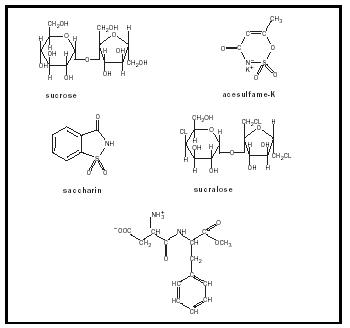
chemistryexplained.com
Non nutritive sweeteners are not all new:  a handful have been around for nearly four decades.  There are some new players to the field because companies are looking for sweeteners that provide better sweetening power that have fewer "off" tastes (like bitterness).  Essentially, the more palatable they can make a sweetener, the better the food tastes and the more product they will sell.

Now the baseline is set, let's get into the meat of the discussion:

In looking for sound research or good website articles, it should go without saying that there are some things that need to be considered:


  1. Who is the publisher?  Do they have any conflicts of interest?
  2. Is the article looking at the research as a whole, or picking and choosing research that supports a viewpoint? (You can truly find research to support any theory you want)
  3. How old is the research?  Is it current? (I consider current anything that has been published within the last 10 years)
  4. What could be other causes to the outcomes of the research?  Do they use good research methodology?
To me, this should be common sense, but it seems many bypass this understanding.  A couple of great, well-rounded, thoroughly researched meta-analysis, recently published articles by top-notch organizations (citations between the two are above 270):


Here's the lowdown on what they say about sweeteners.  "At this time, there are insufficient data to determine conclusively whether the use of NNS to displace caloric sweeteners in beverages and foods reduces added sugars or carbohydrate intakes, or  benefits appetite, energy balance, body weight, or cardiometabolic risk factors." (AHA and ADA article)

"There is no clear evidence that NNS augment appetite by activating cephalic phase responses, altering osmotic balance, or enhancing food palatability. Indeed, there is emerging evidence that selected NNS may stimulate the release of satiety hormones, although the link between these hormones and energy intake in free-living individuals is also open to debate. With respect to energy intake, there is no substantive evidence that inherent liking for sweetness or NNS activation of reward systems is problematic." (AJCN Article).


The last article written by Tufts speaks specifically about the toxicity of aspartame, a concern when aspartame either breaks down in the body or when it is heated about 86 degrees Faranheit.  "Besides cancer concerns, you might be prompted to avoid aspartame because of the claims rocketing around the Internet that it causes everything from lupus to multiple sclerosis to Gulf War Syndrome. These “dangers” are little more than urban legends, according to the American Council on Science and Health: “The scientific evidence does not support any of these alleged associations.”"


From these articles, the acute effects of sweeteners seems to have been found OK, but long term studies are needed to determine further risks.  Keep in mind, however, that's not really a radical statement.  Also, the correlation between artificial sweetener consumption and weight gain may not be causation:  instead it may be caused by the mindset, "I had a diet pop today instead of sugared, so I can have desert tonight".  People over consume sugar as a reward for substituting in artificial sweeteners.  This claim needs more research, but interesting nonetheless. 


There is certainly much more to these research articles that talk about specific concerns with non nutritive sweeteners, so I encourage you to read them - at least the abstracts and conclusions.


As with anything, keep in mind the source of the information your reading.  There are LOTS of bad articles out there about nutrition and exercise.  Don't fall into the trap of websites like these (it's an "all-natural" website looking to sell their products, founded and funded by Joseph Mercola, a known alternative medicine physician that believes sunscreen, drugs, and vaccinations are bad for you).  Media outlets such as newspapers, TV shows (like the TLC article in the first paragraph), blogs (that's ironic, isn't it?) aren't always trustworthy, either.


Feel free to share any further concerns you may have!


Cheers to looking for for the real facts!

Thursday, July 26, 2012

The Power of Social Networks

Take a look at the TED presentation about the power of social networks.  Warning: it's roughly 18 minutes long, so make sure you've got some time on your hands!

The research into social networks is pretty interesting stuff, showing links on why choose certain actions that we do and how our extended network plays a role on our daily living.  This is also very profound in weight loss and weight gain:  the more that obesity becomes the "norm", the easier it is for individuals to accept a unhealthy lifestyle.  As health educators, wellness coordinators, personal trainers, coaches, etc., does this change our approach when counseling or helping someone through a lifestyle behavior change?  Should group counseling and interventions be a tool we use more often?  Just some points to ponder...

Tuesday, July 24, 2012

Milken Institutes, "An Unhealthy America"

While writing some well-being emails for work, I ran across this interesting research done by Milken Institute.  I've never heard of Milken Institute, but some web searches show that it is a reputable, non-profit, non-partisan economic think tank.  The original founder looks a bit shady (Mike Milken, who pleaded guilty to six accounts of securities and tax evasion).  However, the reputation of the Institute seems to have outweighed the founder's woes as it seems to be highly regarded and the accomplishments it has made have been profound.

This research and summary not only looks at the current status of America's health, but looks at trends and projects what the health status will be beyond 2020.  Although not factual and will only be proven with time, it is interesting to see what it will be like if current trends continue.  Just a word of warning:  it's not good.

Here's an interesting tidbit that can whet your palate:
They researched 7 different diseases that accounted for an economic impact of $1.3 trillion annually.  Of this amount $1.1 trillion are due to lost productivity (workplace wellness, people!)

There are some really, really good graphs in there, as well:


This graph also shows the importance and the reason why so many workplace wellness initiatives are trying to find ways to calculate presenteeism.  This metric can make or break a business, and is surely one of greatest things impacted by a wellness movement.

Take a look at it... and let me know if there should be red flags about this institute (ethics, conductivity, etc.).

Thursday, July 19, 2012

"Why & How People Change Health Behaviors" - A Review

My parents would be dumbfounded to read this post.  "Nate writing a book review?!?!"  You see, when growing up, my parents trying to get me to read books was like trying to pull my teeth out.  Unless if it was "Nate the Great" or a picture book, there was no way I was laying my eyes on it.  But, when I found a purpose to read, I became more inclined to take to the pages.  I read now to become more educated, to learn and to become better at what I do.

I recently wrapped up a short reading of "Why & How People Change Health Behaviors" by Joseph Leutzinger and John Harris.  I really shouldn't say it is "written" by these two gents, and here's why:

The book is based off of research that the authors have conducted.  They have completed interviews of 44 individuals that have undergone some health behavior change and have kept that behavior change for some time now.  Common health behavior changes in this book were: quit smoking, weight loss, increase physical activity, diabetes control, depression, etc.  The responses from the interviews are directly transcribed to this book... literally.  Even some grammatical and spelling errors found their way in there (I would assume that these would have been corrected before publishing, but maybe not),  This gives the book a very unique feel and a candid view of the individual, their personality, and what it took for them to accomplish their behavior change.

This was both a good and bad thing.  Good thing for the reasons above, bad thing because it wasn't what I was expecting or hoping for.  When ordering this off of Amazon, I was expecting to find a book that would, at the least, contain a meta-analysis of some good research and provide some great insight into counselling individuals on behavior change.  Even though it didn't fulfill this hope, it was still a good book to read and did provide some thought provoking ideas for myself.

Some themes that I took from this book:

  1. There was almost always a trigger for the behavior change.  Something happened in that individual's life that acted as a catalyst for the change.  Deaths, loved ones getting sick, birth of a child, etc.
  2. Only 1 or 2 times was this trigger a doctor or an authoritative figure that told them they need to change.  Usually these people were ignored until the trigger happened.  This is important to keep in mind for health educators, personal trainers, doctors, etc.  The initial motivation to change something must come from the individual, and not from an outside source.  Their mind seems to have to "click" and it take a powerful and emotional event for this to happen.
  3. Motivation must come from the individual and the reason for the behavior change must be personal.  Many times the interviewees said "you must change for yourself and not for anyone else".
  4. Support group > mentors.  Many people said their support group(s) (coworkers, family, friends) were essential to their success, but very few actually had mentors.
  5. Environment was essential for the majority of them.  Some individuals even had to change their environment to be successful.  Meaning, they had to change jobs, move somewhere else, find a new church, etc.  
  6. Personality typing seems to play a critical role in how the person initiates and maintains their behavior change.  As a result, learning how to personality type and how to use their personality type to help them with behavior change is probably something I will look into further. 
  7. For the corporate wellness coordinator:  a handful of individuals said that their workplace wellness program was useful or integral in their success.  Whether it was a weight loss program, smoking cessation program or an on-site fitness facility, these people said it made it very easy to start or continue their behavior change.
All in all, it was an interesting book.  Not something I would put at the top of my reading list, but definitely a useful tool to have and it did spur some thought provoking questions.

Cheers to reading and being more educated!


Saturday, June 23, 2012

The Weight of Nations

I thought this article was interesting enough to highlight it from the "Articles" page.  It talks about the average weight of certain populations and uses that country's population numbers to calculate the % weight of the entire world.  The article highlights two countries:

Source: NASA
Asia has 61% of the world's population, but their average weight is low so it takes up only 13% of the world's total biomass.

North America however, has 6% of the world's population, but takes up 34% of the total biomass.  This is due to an  18.7 kg increase in average mass for this continent over the average 62kg of the world.


Source